How to read a BC strata depreciation report in 15 minutes
Every BC strata must produce one. Most buyers skip them. Here's a systematic read that takes 15 minutes and surfaces the three numbers that actually matter for your offer price.
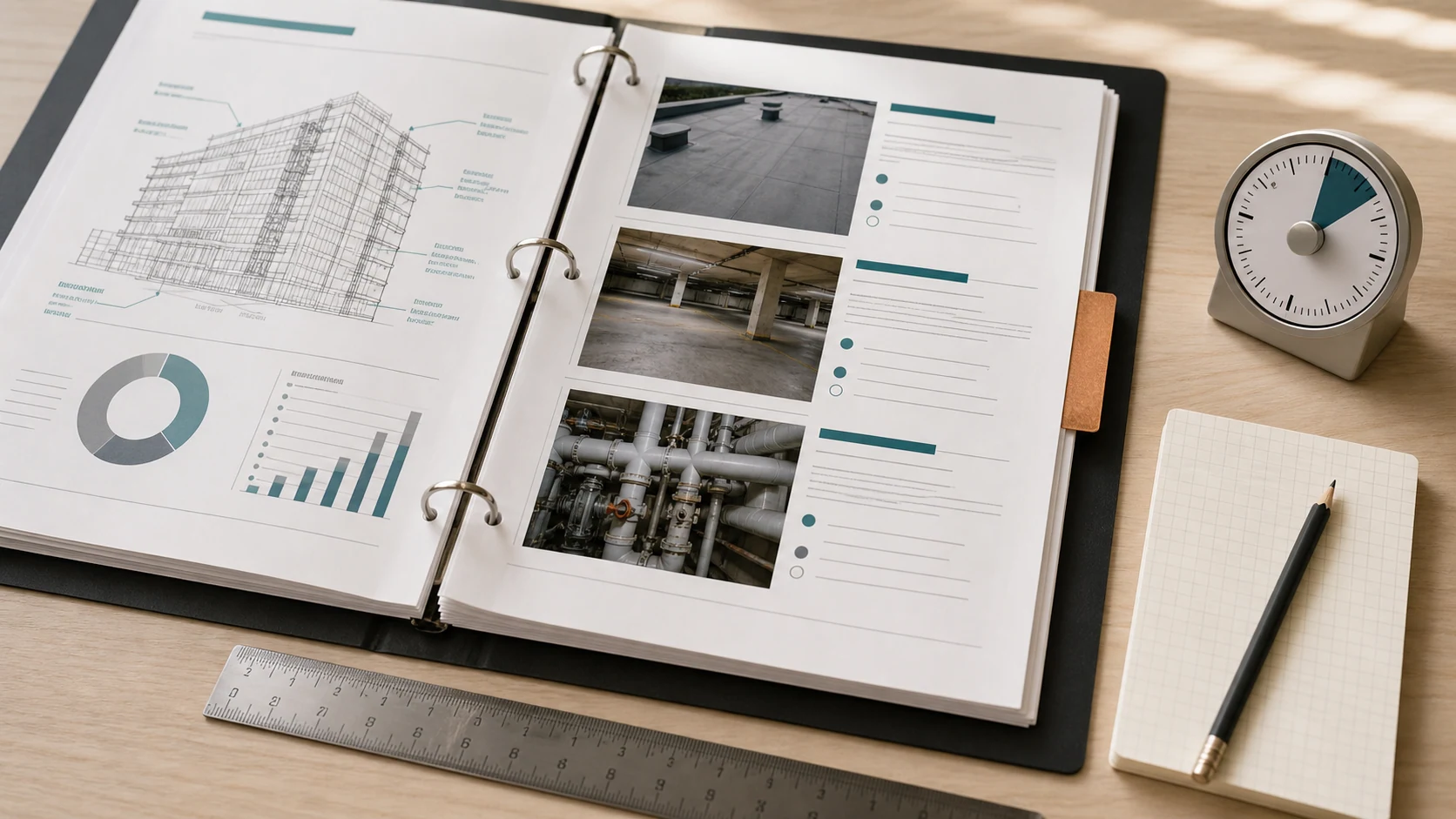
Most condo risk is not visible in the listing photos. It sits in the roof schedule, the parkade membrane allowance, the elevator reserve, and the gap between what the strata has saved and what the building is likely to need.
That is what a depreciation report is meant to surface.
Under BC’s Strata Property Act and regulations, strata corporations with five or more strata lots must obtain depreciation reports from a qualified provider on a five-year cycle. Older packages may still reference the former three-year cycle, so check the report date before relying on it. The report estimates repair and replacement costs for major common-property and common-asset components over a long horizon.
You can read the whole report. You should. But the first pass should take 15 minutes and focus on three numbers.
1. Current CRF balance
The contingency reserve fund is the strata’s capital reserve. It is not the operating budget. It is the pool used for major repair and replacement items: roofs, windows, membranes, boilers, elevators, envelope work, and similar building systems.
Start with the current CRF balance in the financial statements, then reconcile it against the balance assumed in the depreciation report. If the report is 18 months old and the minutes show major spending since then, the report’s funding model may already be stale.
2. Fully funded target
The report should show a funding model. Look for the amount the strata would need to have, or contribute over time, to meet the building’s projected component inventory without repeated special levies.
There is no universal target that works for every building. A four-year-old low-rise and a 32-year-old concrete tower have different risk profiles. The number that matters is the target relative to age, component condition, and near-term spending.
3. The gap
Subtract the current CRF from the funding target. That gap is not guaranteed debt, but it is a contingent liability attached to the unit.
If the building needs $3 million of near-term work and has $600,000 in reserve, the missing $2.4 million has only a few places to go: higher strata fees, borrowing, a special levy, deferred maintenance, or a combination of all four.
Deferral shows up in the schedule
The 10-year major spending plan is where maintenance deferral becomes visible. Look for line items that were expected soon but keep rolling forward across report versions: roof work moved from 2023 to 2026, parkade membrane repairs moved again, plumbing investigation postponed without a clear engineering reason.
Deferral is not always mismanagement. Sometimes the strata has better engineering information. But repeated movement of near-term capital items without matching reserve growth is a red flag.
Model special levy risk
If the CRF is below 25% of the fully funded target, model a special levy into your offer price. That does not mean the levy is certain. It means the building is undercapitalized enough that your maximum price should reflect the risk.
Use the gap number as a contingent liability. Divide it by unit entitlement if the report and strata documents support that method, then adjust for timing, urgency, and whether the work is optional or unavoidable.
Depreciation reports are estimates. Confirm the conclusions against the strata’s financial statements, council minutes, annual general meeting minutes, insurance renewals, engineering reports, and Form B before treating the number as final.
HOMS Real Estate Services Corp. is a technology, intelligence and multidisciplinary services company and is not a licensed real estate brokerage.Licensed real estate trading services are provided by Moji Dargahi, licensed real estate professional with Royal Pacific Realty Corp.HOMS is not an engineering firm: analysis outputs are preliminary screening estimates for informational purposes and are not sealed engineering documents. Tool outputs are estimates for informational purposes only and do not constitute an appraisal, recommendation, financial advice or legal advice. Fit results compare listing data with numbers you enter; they are not a pre-approval.